
What does strategy mean?
The word strategy is of Greek origin and refers to generalship and military art.
When you strategise for your business, you are in some ways a like an army leader. You can think about how in military circles the expression is used to lay down a strategy for a campaign, and it implies taking a position on, among other things:
- What is the mission of the campaign?
- On which battlefield will the battle take place?
- What is the strength of the enemy?
- Which combat forces must be used?
- How should the troops be composed, positioned and deployed?
- How are the supply lines secured?
In your own company, your considerations as a manager are in many ways similar to the considerations of military strategists:
- Which customer needs & wants should we cover? With which products and services?
- Which markets should we work on?
- What should be our competitive platform?
- What resources must stand behind our company, and how should they be put together?
- How do we ensure access to the necessary resources?
However, the notion of “company strategy” has often become almost meaningless.
Why? Because its definition has been diluted and used almost interchangeably with tactics and other concepts.
One of the best ways to assess business strategising is to think of it as a major change to the company and its place in the business terrain.
To elaborate on this further, it is useful to first consider what makes up your company’s “strategic profile”.
Your company’s strategic profile is a description of its position in the business environment and of your company’s structure in broad terms.
A strategic profile is a description of your company at a certain point in time, while the term strategising is about changing the strategic profile.
When you strategise it is therefore about making changes to your company’s strategic profile – and thus in your company’s position in the business environment and in its structure in broad terms.
You can assess the future viability of your company’s strategic profile and consider new strategies when you take into account the current and future conditions within the four key areas.
Business strategising involves a relatively significant change of your company and its placement in the business terrain.
Current strategic profile > Strategies > Future strategic profile
How do you apply the most useful and comprehensive assessment of your current business profile?
As a starting point, consider what constitutes your business basis (areas of operation, what functions you undertake in the overall industry, and the basis on which your company builds its competitiveness) and equally your business’s structural composition (how your business is composed, constituted and arranged, so that it can function and deliver its operations).
In the process of strategy review & intervention, you can distinguish between firstly describing and analysing your “strategic profile” your company at a certain point in time, and secondly the actual strategising which is the subsequent changes you make and implement in your company’s strategic profile.
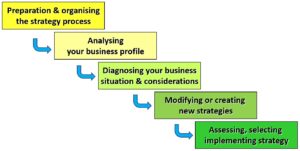
When you strategise, you are therefore developing and implementing new markets, products, technologies, sales channels, suppliers, partners, etc — or you could be dismantling certain markets, products, technologies, etc, and/or making improvements to your competitiveness, products, technologies, etc.
You strategies are the changes you make in your company’s strategic profile – and thus of your position in the business terrain and of its structure in broad terms.
As you can see in the figure below, your company’s current strategic profile should be at the centre of the strategic management work. The assessment of the viability of your strategic profile in the future and the appraisal of new strategies take place whilst taking into account the current and future conditions within the 4 main areas.
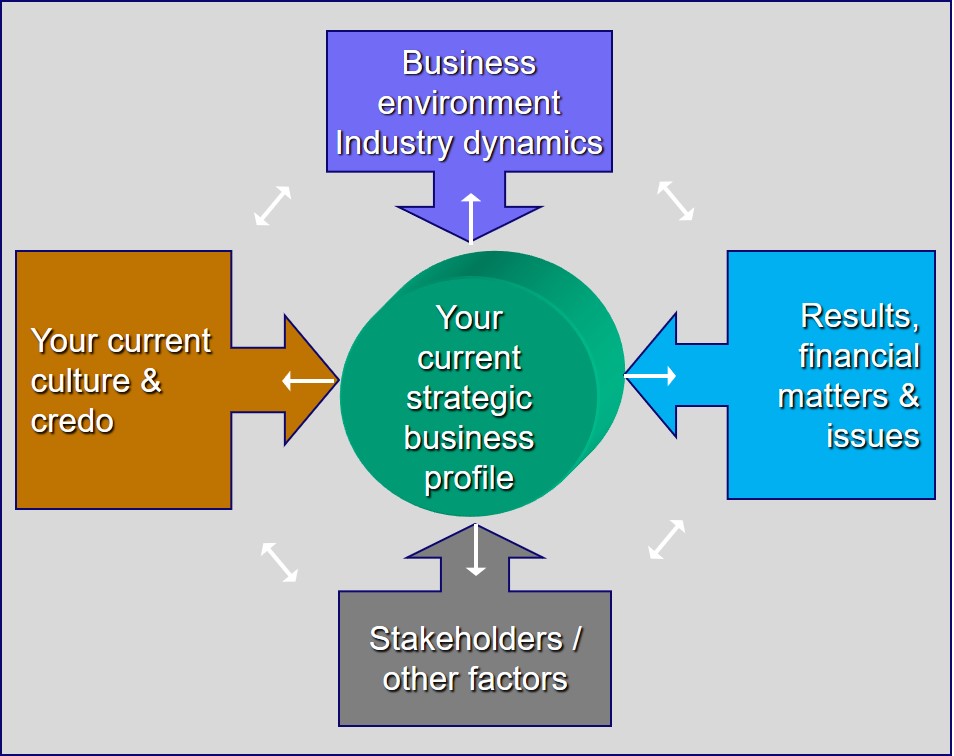
How can developments in the outside world take shape? In which areas does your company have to adapt to developments in order to manoeuvre around dangerous obstacles? In which areas can your company benefit from the development and enter new opportunities? What reactions in the outside world can your company expect from any new initiatives?
Is there a disharmony between any stakeholders demands on your company and your strategic profile? Are there any changes in the horizon for any stakeholders, legislative requirements, or anything else that is PESTLE related? How will stakeholders likely react to your company’s new strategies?
Should your company’s past traditions and dominant perceptions be continued, or can changes be accepted? Should the company maintain its freedom of action at all costs? How much risk do we want to take? What do we want to deal with in the future?
How will your company’s finances and other results develop? Are the earnings acceptable? Will the company be able to finance the liquidity needs? In which market areas are we successful? Can these be used as a springboard for any strategic initiatives?
What weaknesses does your company’s strategic profile contain? Is the business area too narrow? Is the competitive basis weak? How is your company’s financial preparedness? What risks or direct threats to the company’s existence do these weaknesses pose? Does your company have special advantages or superior expertise? What possibilities can come into question against this background?
Business Expert On-call service (subscription) – get more info now
I help businesses such as yours apply practical, viable improvements in strategy, business processes and strategic marketing.
This increases your sales, controls costs and improves your “bottom line”.
You can have an on-call expert to work with you to improve your business performance.
If you’d like to know how I do this, and how I may be able to help you, let’s arrange a free meeting without obligation.
- Get an impartial view on your business matters (from someone who understands).
- Realise untapped potential.
- Professionalise your management processes: prevent them from becoming a series of expanded staff meetings.
- Decrease the learning curve, using our expertise in implementing strategic processes.
- Resolve conflict, bring out the best in your team, think outside the box.
- Ensure cost efficiency: move your key projects along in a timely, effective manner.
Call for an initial discussion 020 3000 2620.

On-call expert ...
... will work with you to grow your business and increase your sales.

Solved? The growth conundrum
Could we (try to) resolve your problems with growing your company?

How to protect your revenues
... by improving business processes in a methodical way.

Efficiency & Effectiveness?
It’s been said that, in order to run your business really well, you have to be both efficient and effective. How to sort out the confusion...